Skip to content

Concept Vector Projection

Concept Vector Projection is an embedding-based method for extracting continuous sentiment (or other) scores from free-text documents.
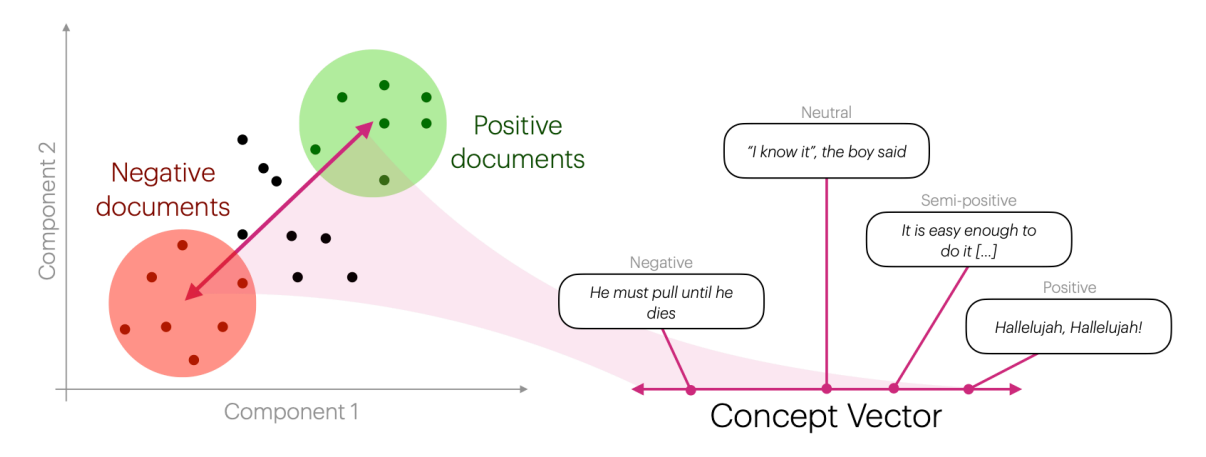
Figure 1: Schematic Overview of Concept Vector Projection.
Figure from Lyngbæk et al. (2025)

The method rests on the idea that one can construct a concept vector by encoding positive and negative seed phrases with a transformer, then taking the difference of these mean vectors. We can then project other documents' embeddings onto these concept vectors by taking the dot product with the concept vector, thereby giving continuous scores on how related documents are to a given concept.

Usage

Single Concept

When projecting onto a single concept, you should specify the seeds as a tuple of positive and negative phrases.

from turftopic import ConceptVectorProjection

positive = [
    "I love this product",
    "This is absolutely lovely",
    "My daughter is going to adore this"
]
negative = [
    "This product is not at all as advertised, I'm very displeased",
    "I hate this",
    "What a horrible way to deal with people"
]
cvp = ConceptVectorProjection(seeds=(positive, negative))

test_documents = ["My cute little doggy", "Few this is digusting"]
doc_concept_matrix = cvp.transform(test_documents)
print(doc_concept_matrix)
[[0.24265897]
 [0.01709663]]

Multiple Concepts

When projecting documents to multiple concepts at once, you will need to specify seeds for each concept, as well as its name. Internally this is handled with an OrderedDict, which you can either specify yourself, or Turftopic can do it for you:

import pandas as pd
from collections import OrderedDict

cuteness_seeds = (["Absolutely adorable", "I love how he dances with his little feet"], ["What a big slob of an abomination", "A suspicious old man sat next to me on the bus today"])
bullish_seeds = (["We are going to the moon", "This stock will prove an incredible investment"], ["I will short the hell out of them", "Uber stocks drop 7% in value after down-time."])

# Either specify it like this:
seeds = [("cuteness", cuteness_seeds), ("bullish", bullish_seeds)]
# or as an OrderedDict:
seeds = OrderedDict([("cuteness", cuteness_seeds), ("bullish", bullish_seeds)])
cvp = ConceptVectorProjection(seeds=seeds)

test_documents = ["What an awesome investment", "Tiny beautiful kitty-cat"]
doc_concept_matrix = cvp.transform(test_documents)
concept_df = pd.DataFrame(doc_concept_matrix, columns=cvp.get_feature_names_out())
print(concept_df)
   cuteness   bullish
0  0.085957  0.288779
1  0.269454  0.009495

Sentiment Arcs

Sometimes you might want to get a more granular understanding of how concepts evolve in a document. ConceptVectorProjection can be used with late-interaction/multi-vector functionality in Turftopic, and thus you can easily generate sentiment arcs within documents that either span individual tokens or contextualized rolling windows.

Tip

To get a more in-depth understanding of late-interaction/multi-vector models, read our User Guide.

from turftopic import LateCVP
# For plotting:
import plotly.express as px
import plotly.graph_objects as go

seeds = [("cuteness", cuteness_seeds), ("bullish", bullish_seeds)]

cvp = LateCVP(seeds=seeds)
test_documents = ["What an awesome investment", "Tiny beautiful kitty-cat"]
doc_concept_matrix, offsets = cvp.transform(test_documents)

# We will plot document 0's' sentiment arcs
fig = go.Figure()
# We extract the tokens
tokens = [test_documents[0][start:end] for start, end in offsets[0]]
# First token is [CLS]
tokens[0] = "[CLS]"
fig = fig.add_scatter(x=tokens, y=doc_concept_matrix[0][:, 0], name="Cuteness")
fig = fig.add_scatter(x=tokens, y=doc_concept_matrix[0][:, 1], name="Bullish")
fig.show()
Figure 2: Concepts evolving over tokens in the first document.

Citation

Please cite Lyngbæk et al. (2025) and Turftopic when using Concept Vector Projection in publications:

@article{
  Kardos2025,
  title = {Turftopic: Topic Modelling with Contextual Representations from Sentence Transformers},
  doi = {10.21105/joss.08183},
  url = {https://doi.org/10.21105/joss.08183},
  year = {2025},
  publisher = {The Open Journal},
  volume = {10},
  number = {111},
  pages = {8183},
  author = {Kardos, Márton and Enevoldsen, Kenneth C. and Kostkan, Jan and Kristensen-McLachlan, Ross Deans and Rocca, Roberta},
  journal = {Journal of Open Source Software} 
}

@incollection{Lyngbaek2025,
  title = {Continuous Sentiment Scores for Literary and Multilingual
Contexts},
  author = {Laurits Lyngbaek and Pascale Feldkamp and Yuri Bizzoni and Kristoffer L. Nielbo and Kenneth Enevoldsen},
  year = {2025},
  booktitle = {Computational Humanities Research 2025},
  publisher = {Anthology of Computers and the Humanities},
  pages = {480--497},
  editor = {Taylor Arnold and Margherita Fantoli and Ruben Ros},
  doi = {10.63744/nVu1Zq5gRkuD}
}

API Reference

turftopic.models.cvp.ConceptVectorProjection

Bases: ContextualModel

Concept Vector Projection model from Lyngbæk et al. (2025) Can be used to project document embeddings onto a difference projection vector between positive and negative seed phrases. The primary use case is sentiment analysis, and continuous sentiment scores, especially for languages where dedicated models are not available.

Parameters:

Name Type Description Default
seeds Union[Seeds, list[tuple[str, Seeds]], OrderedDict[str, Seeds]]

If you want to project to a single concept, then a tuple of (list of negative terms, list of positive terms).
If there are multiple concepts, they should be specified as (name, Seeds) tuples in a list. Alternatively, seeds can be an OrderedDict with the names of the concepts being the keys, and the tuples of negative and positive seeds as the values.

required
encoder Union[Encoder, str, MultimodalEncoder]

Model to produce document representations, paraphrase-multilingual-mpnet-base-v2 is the default per Lyngbæk et al. (2025).

'sentence-transformers/paraphrase-multilingual-mpnet-base-v2'
trf_kwargs

Keyword arguments to apply when loading the Encoder model.

None
encode_kwargs

Keyword arguments to apply encoding documents with the encoder.

None
Source code in turftopic/models/cvp.py
 14
 15
 16
 17
 18
 19
 20
 21
 22
 23
 24
 25
 26
 27
 28
 29
 30
 31
 32
 33
 34
 35
 36
 37
 38
 39
 40
 41
 42
 43
 44
 45
 46
 47
 48
 49
 50
 51
 52
 53
 54
 55
 56
 57
 58
 59
 60
 61
 62
 63
 64
 65
 66
 67
 68
 69
 70
 71
 72
 73
 74
 75
 76
 77
 78
 79
 80
 81
 82
 83
 84
 85
 86
 87
 88
 89
 90
 91
 92
 93
 94
 95
 96
 97
 98
 99
100
101
102
103
104
105
106
107
108
109
110
111
112
class ConceptVectorProjection(ContextualModel):
    """Concept Vector Projection model from [Lyngbæk et al. (2025)](https://doi.org/10.63744/nVu1Zq5gRkuD)
    Can be used to project document embeddings onto a difference projection vector between positive and negative seed phrases.
    The primary use case is sentiment analysis, and continuous sentiment scores,
    especially for languages where dedicated models are not available.

    Parameters
    ----------
    seeds: (list[str], list[str]) or list of (str, (list[str], list[str]))
        If you want to project to a single concept, then
        a tuple of (list of negative terms, list of positive terms). <br>
        If there are multiple concepts, they should be specified as (name, Seeds) tuples in a list.
        Alternatively, seeds can be an OrderedDict with the names of the concepts being the keys,
        and the tuples of negative and positive seeds as the values.
    encoder: str or SentenceTransformer
        Model to produce document representations, paraphrase-multilingual-mpnet-base-v2 is the default
        per Lyngbæk et al. (2025).
    trf_kwargs: dict, default None
        Keyword arguments to apply when loading the Encoder model.
    encode_kwargs: dict, default None
        Keyword arguments to apply encoding documents with the encoder.
    """

    def __init__(
        self,
        seeds: Union[Seeds, list[tuple[str, Seeds]], OrderedDict[str, Seeds]],
        encoder: Union[
            Encoder, str, MultimodalEncoder
        ] = "sentence-transformers/paraphrase-multilingual-mpnet-base-v2",
        trf_kwargs=None,
        encode_kwargs=None,
    ):
        self.seeds = seeds
        if isinstance(seeds, OrderedDict):
            self._seeds = seeds
        elif (
            (len(seeds) == 2)
            and (isinstance(seeds, tuple))
            and (isinstance(seeds[0][0], str))
        ):
            self._seeds = OrderedDict([("default", seeds)])
        else:
            self._seeds = OrderedDict(seeds)
        self.encoder = encoder
        self.trf_kwargs = trf_kwargs
        self.encode_kwargs = encode_kwargs
        self.load_encoder()
        self.classes_ = np.array([name for name in self._seeds])
        self.concept_matrix_ = []
        for _, (positive, negative) in self._seeds.items():
            positive_emb = self.encode_documents(list(positive))
            negative_emb = self.encode_documents(list(negative))
            cv = np.mean(positive_emb, axis=0) - np.mean(negative_emb, axis=0)
            self.concept_matrix_.append(cv / np.linalg.norm(cv))
        self.concept_matrix_ = np.stack(self.concept_matrix_)

    def get_feature_names_out(self):
        """Returns concept names in an array."""
        return self.classes_

    def fit_transform(self, raw_documents=None, y=None, embeddings=None):
        """Project documents onto the concept vectors.

        Parameters
        ----------
        raw_documents: list[str] or None
            List of documents to project to the concept vectors.
        embeddings: ndarray of shape (n_documents, n_dimensions)
            Document embeddings (has to be created with the same encoder as the concept vectors.)

        Returns
        -------
        document_concept_matrix: ndarray of shape (n_documents, n_dimensions)
            Prevalance of each concept in each document.
        """
        if (raw_documents is None) and (embeddings is None):
            raise ValueError(
                "Either embeddings or raw_documents has to be passed, both are None."
            )
        if embeddings is None:
            embeddings = self.encode_documents(list(raw_documents))
        return embeddings @ self.concept_matrix_.T

    def transform(self, raw_documents=None, embeddings=None):
        """Project documents onto the concept vectors.

        Parameters
        ----------
        raw_documents: list[str] or None
            List of documents to project to the concept vectors.
        embeddings: ndarray of shape (n_documents, n_dimensions)
            Document embeddings (has to be created with the same encoder as the concept vectors.)

        Returns
        -------
        document_concept_matrix: ndarray of shape (n_documents, n_dimensions)
            Prevalance of each concept in each document.
        """
        return self.fit_transform(raw_documents, embeddings=embeddings)

fit_transform(raw_documents=None, y=None, embeddings=None)

Project documents onto the concept vectors.

Parameters:

Name Type Description Default
raw_documents

List of documents to project to the concept vectors.

None
embeddings

Document embeddings (has to be created with the same encoder as the concept vectors.)

None

Returns:

Name Type Description
document_concept_matrix ndarray of shape (n_documents, n_dimensions)

Prevalance of each concept in each document.

Source code in turftopic/models/cvp.py
74
75
76
77
78
79
80
81
82
83
84
85
86
87
88
89
90
91
92
93
94
95
def fit_transform(self, raw_documents=None, y=None, embeddings=None):
    """Project documents onto the concept vectors.

    Parameters
    ----------
    raw_documents: list[str] or None
        List of documents to project to the concept vectors.
    embeddings: ndarray of shape (n_documents, n_dimensions)
        Document embeddings (has to be created with the same encoder as the concept vectors.)

    Returns
    -------
    document_concept_matrix: ndarray of shape (n_documents, n_dimensions)
        Prevalance of each concept in each document.
    """
    if (raw_documents is None) and (embeddings is None):
        raise ValueError(
            "Either embeddings or raw_documents has to be passed, both are None."
        )
    if embeddings is None:
        embeddings = self.encode_documents(list(raw_documents))
    return embeddings @ self.concept_matrix_.T

get_feature_names_out()

Returns concept names in an array.

Source code in turftopic/models/cvp.py
70
71
72
def get_feature_names_out(self):
    """Returns concept names in an array."""
    return self.classes_

transform(raw_documents=None, embeddings=None)

Project documents onto the concept vectors.

Parameters:

Name Type Description Default
raw_documents

List of documents to project to the concept vectors.

None
embeddings

Document embeddings (has to be created with the same encoder as the concept vectors.)

None

Returns:

Name Type Description
document_concept_matrix ndarray of shape (n_documents, n_dimensions)

Prevalance of each concept in each document.

Source code in turftopic/models/cvp.py
 97
 98
 99
100
101
102
103
104
105
106
107
108
109
110
111
112
def transform(self, raw_documents=None, embeddings=None):
    """Project documents onto the concept vectors.

    Parameters
    ----------
    raw_documents: list[str] or None
        List of documents to project to the concept vectors.
    embeddings: ndarray of shape (n_documents, n_dimensions)
        Document embeddings (has to be created with the same encoder as the concept vectors.)

    Returns
    -------
    document_concept_matrix: ndarray of shape (n_documents, n_dimensions)
        Prevalance of each concept in each document.
    """
    return self.fit_transform(raw_documents, embeddings=embeddings)

turftopic.models.cvp.LateCVP

Bases: LateModel

Late-interaction (multi-vector) Concept Vector Projection model from Lyngbæk et al. (2025) Can be used to project document embeddings onto a difference projection vector between positive and negative seed phrases. The primary use case is sentiment analysis, and continuous sentiment scores, especially for languages where dedicated models are not available.

Parameters:

Name Type Description Default
seeds Union[Seeds, list[tuple[str, Seeds]], OrderedDict[str, Seeds]]

If you want to project to a single concept, then a tuple of (list of negative terms, list of positive terms).
If there are multiple concepts, they should be specified as (name, Seeds) tuples in a list. Alternatively, seeds can be an OrderedDict with the names of the concepts being the keys, and the tuples of negative and positive seeds as the values.

required
encoder Union[Encoder, str, MultimodalEncoder]

Model to produce document representations, paraphrase-multilingual-mpnet-base-v2 is the default per Lyngbæk et al. (2025).

'sentence-transformers/paraphrase-multilingual-mpnet-base-v2'
span_extractor SpanExtractor | Literal['sentence'] | None

Object that extracts arbitrary spans from a piece of text. These spans will then be used to pool token embeddings. This could for instance be a SentenceSeparator.

None
include_edge_tokens bool

Indicates whether the tokens on the edges of spans (ones that go over the span boundary) should be included in the span embedding. Ignored when not using a span extractor.

True
window_size int | None

Size of the sliding window to average tokens over. If None, documents will be represented at a token level.

None
step_size int | None

Step size of the window. If (step_size == None) or (step_size == window_size), then windows are separate. If step_size < window_size, windows will overlap. If step_size > window_size, there will be gaps between the windows. In this case, we throw a warning, as this is probably unintended behaviour.

None
pooling

Indicates whether and how to pool document-topic matrices. If None, multi-vector topic proportions are returned in a ragged array. If Callable, multiple vectors are averaged with the callable in each document. You could for example take the mean by specifying pooling=np.nanmean.

None
trf_kwargs

Keyword arguments to apply when loading the Encoder model.

None
encode_kwargs

Keyword arguments to apply encoding documents with the encoder.

None
Source code in turftopic/models/cvp.py
115
116
117
118
119
120
121
122
123
124
125
126
127
128
129
130
131
132
133
134
135
136
137
138
139
140
141
142
143
144
145
146
147
148
149
150
151
152
153
154
155
156
157
158
159
160
161
162
163
164
165
166
167
168
169
170
171
172
173
174
175
176
177
178
179
180
181
182
183
184
185
186
187
188
189
190
191
192
193
194
195
196
197
198
199
200
201
202
203
204
205
206
207
208
209
210
211
212
213
214
215
216
217
218
219
220
221
222
223
224
225
226
227
class LateCVP(LateModel):
    """Late-interaction (multi-vector) Concept Vector Projection model from [Lyngbæk et al. (2025)](https://doi.org/10.63744/nVu1Zq5gRkuD)
    Can be used to project document embeddings onto a difference projection vector between positive and negative seed phrases.
    The primary use case is sentiment analysis, and continuous sentiment scores,
    especially for languages where dedicated models are not available.

    Parameters
    ----------
    seeds: (list[str], list[str]) or list of (str, (list[str], list[str]))
        If you want to project to a single concept, then
        a tuple of (list of negative terms, list of positive terms). <br>
        If there are multiple concepts, they should be specified as (name, Seeds) tuples in a list.
        Alternatively, seeds can be an OrderedDict with the names of the concepts being the keys,
        and the tuples of negative and positive seeds as the values.
    encoder: str or SentenceTransformer
        Model to produce document representations, paraphrase-multilingual-mpnet-base-v2 is the default
        per Lyngbæk et al. (2025).
    span_extractor: SpanExtractor, default None
        Object that extracts arbitrary spans from a piece of text.
        These spans will then be used to pool token embeddings.
        This could for instance be a SentenceSeparator.
    include_edge_tokens: bool, default True
        Indicates whether the tokens on the edges of spans (ones that go over the span boundary)
        should be included in the span embedding.
        Ignored when not using a span extractor.
    window_size: int, default None
        Size of the sliding window to average tokens over.
        If None, documents will be represented at a token level.
    step_size: int, default None
        Step size of the window.
        If (step_size == None) or (step_size == window_size), then windows are separate.
        If step_size < window_size, windows will overlap.
        If step_size > window_size, there will be gaps between the windows.
        In this case, we throw a warning, as this is probably unintended behaviour.
    pooling: Callable, default None
        Indicates whether and how to pool document-topic matrices.
        If None, multi-vector topic proportions are returned in a ragged array.
        If Callable, multiple vectors are averaged with the callable in each document.
        You could for example take the mean by specifying `pooling=np.nanmean`.
    trf_kwargs: dict, default None
        Keyword arguments to apply when loading the Encoder model.
    encode_kwargs: dict, default None
        Keyword arguments to apply encoding documents with the encoder.
    """

    def __init__(
        self,
        seeds: Union[Seeds, list[tuple[str, Seeds]], OrderedDict[str, Seeds]],
        encoder: Union[
            Encoder, str, MultimodalEncoder
        ] = "sentence-transformers/paraphrase-multilingual-mpnet-base-v2",
        span_extractor: SpanExtractor | Literal["sentence"] | None = None,
        include_edge_tokens: bool = True,
        window_size: int | None = None,
        step_size: int | None = None,
        pooling=None,
        trf_kwargs=None,
        encode_kwargs=None,
    ):
        self.seeds = seeds
        if isinstance(seeds, OrderedDict):
            self._seeds = seeds
        elif (
            (len(seeds) == 2)
            and (isinstance(seeds, tuple))
            and (isinstance(seeds[0][0], str))
        ):
            self._seeds = OrderedDict([("default", seeds)])
        else:
            self._seeds = OrderedDict(seeds)
        self.encoder = encoder
        self.trf_kwargs = trf_kwargs
        self.encode_kwargs = encode_kwargs
        self.load_encoder()
        self.classes_ = np.array([name for name in self._seeds])
        self.concept_matrix_ = []
        self.window_size = window_size
        self.span_extractor = span_extractor
        self.include_edge_tokens = include_edge_tokens
        self.step_size = step_size
        self.pooling = pooling
        for _, (positive, negative) in self._seeds.items():
            positive_emb = self.encode_documents(list(positive))
            negative_emb = self.encode_documents(list(negative))
            cv = np.mean(positive_emb, axis=0) - np.mean(negative_emb, axis=0)
            self.concept_matrix_.append(cv / np.linalg.norm(cv))
        self.concept_matrix_ = np.stack(self.concept_matrix_)

    def get_feature_names_out(self):
        """Returns concept names in an array."""
        return self.classes_

    def fit_transform(
        self,
        raw_documents=None,
        embeddings: np.ndarray | None = None,
        offsets: Offsets | None = None,
    ) -> RaggedArray | np.ndarray:
        if (embeddings is None) or (offsets is None):
            embeddings, offsets = self.encode_late(raw_documents)
        doc_topic_matrix = [emb @ self.concept_matrix_.T for emb in embeddings]
        return self.pool(doc_topic_matrix, offsets)

    def transform(
        self,
        raw_documents=None,
        embeddings: np.ndarray | None = None,
        offsets: Offsets | None = None,
    ) -> RaggedArray | np.ndarray:
        if (embeddings is None) or (offsets is None):
            embeddings, offsets = self.encode_late(raw_documents)
        doc_topic_matrix = [emb @ self.concept_matrix_.T for emb in embeddings]
        return self.pool(doc_topic_matrix, offsets)

get_feature_names_out()

Returns concept names in an array.

Source code in turftopic/models/cvp.py
203
204
205
def get_feature_names_out(self):
    """Returns concept names in an array."""
    return self.classes_